
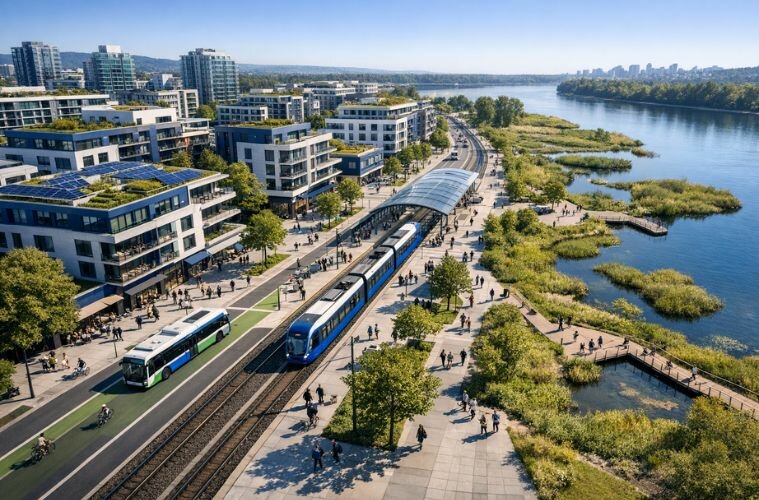
The C40 Cities and United Nations Human Settlements Programme (UN-Habitat) Urban Planning Accelerator was a centerpiece of the World Urban Forum (WUF) in Baku, Azerbaijan, on May 20, 2026. Originally unveiled at the C40 World Mayors Summit in Rio de Janeiro last November, the initiative now has 33 major cities formally on record committing to a climate-responsive urban planning model by 2035. The list spans six continents and includes Chicago, Paris, Tokyo, Jakarta, Karachi, Johannesburg, and 27 others.
Signatory cities agree to prioritize densification over urban sprawl, restrict new development in high climate-risk zones, protect and restore natural systems that buffer against extreme weather, and embed climate risk data directly into master plans and land-use frameworks. Transit-oriented development and mixed-use neighborhoods are central to the model. The accelerator provides cities with technical support, policy guidance, and access to peer learning networks to implement these shifts at the local planning level.
The context behind the initiative is straightforward and has been building for years. Urban land area is currently expanding up to 50% faster than population growth globally. If that trend continues, urban areas could triple in size by 2050. Green spaces in and around cities have shrunk by nearly 29% between 1990 and 2020. More than one billion people live in slums or informal settlements today. The Intergovernmental Panel on Climate Change (IPCC) has projected that cities adopting compact, mixed-use, transit-oriented planning models could cut greenhouse gas (GHG) emissions by up to 26% by 2050. The gap between that potential and current urban development trajectories is what the accelerator is designed to close.
Separately, C40 Cities and the Global Covenant of Mayors for Climate and Energy (GCoM) used the Baku forum to discuss urban climate finance alongside multilateral development banks, building on a report C40 published on adaptation finance and a recent high-level roundtable between development banks and mayors. Access to funding remains one of the most consistent barriers cities cite when moving from planning commitments to implementation, particularly for resilience infrastructure, sustainable mobility, and affordable housing.


