
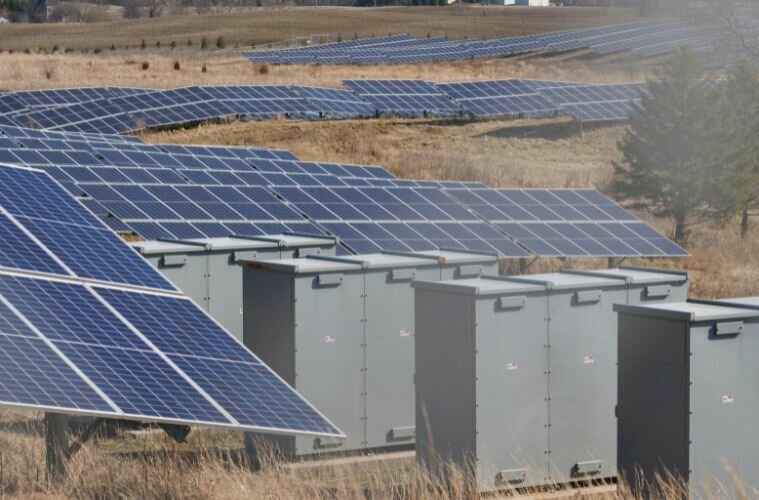
The U.S. added 7.8 gigawatts (GW) of new solar capacity in the first quarter of 2026, with solar and energy storage together accounting for 91% of all new power added to the grid, according to the U.S. Solar Market Insight 2026 Q2 Report released by the Solar Energy Industries Association (SEIA) and Wood Mackenzie. The quarter pushed cumulative U.S. solar installations past six million. Solar now generates nearly 9% of U.S. electricity, roughly seven times its share a decade ago, and 51% of all capacity added in 2025 was solar, according to the SEIA's June 2026 data sheet.
Utility-scale solar contracts rose 15% year over year in Q1, driven largely by technology companies securing power purchase agreements to meet electricity demand from AI infrastructure. States that voted for President Trump in 2024 accounted for 74% of all solar capacity installed during the quarter, with Texas, Florida, Ohio, Indiana, Michigan, Arizona, and Mississippi ranking among the top ten states for new additions.
Permitting Delays Have Flattened the Five-Year Deployment Forecast
Despite the strong Q1 numbers, Wood Mackenzie revised its forward outlook to flat growth over the next five years. The constraint is not demand, which continues to climb, or procurement, which is accelerating. The constraint is permitting. SEIA identified 457 solar and storage projects with permits pending that it describes as vulnerable to delay or cancellation. The report noted that current permitting bottlenecks are functioning as a near-term ceiling on how much of the contracted pipeline can actually reach operation on schedule. Wood Mackenzie's head of solar described the mismatch between utility resource planning, which is adding more solar to long-term forecasts, and near-term project execution, which remains bottlenecked, as the defining tension in the current market.
Residential Solar Contracting While Battery Pairing Hits Record
The residential market is expected to decline 21% in 2026 before returning to consistent growth between 2027 and 2031. Within Q1, however, a record 45% of residential solar installations were paired with battery energy storage, a figure that reflects growing homeowner interest in backup power independent of grid conditions. On the manufacturing side, $18 billion has been invested in U.S. solar factories, with 70 GW of module manufacturing capacity operational and another 16 GW under construction. Cell manufacturing stands at 3.2 GW operational and 25 GW under construction. The SEIA projects cumulative U.S. solar capacity will reach 769 GW by 2036, with solar expected to supply roughly half of all new capacity additions annually through 2060.


