
There is a math problem sitting at the center of urban electrification that nobody has solved cleanly yet. Builders want to add heat pumps and EV chargers. Existing electrical panels were not designed for that load. Service upgrades are expensive, slow, and often logistically complicated in dense neighborhoods. So projects stall, or builders make concessions they should not have to make.
Toronto Hydro is trying something different.
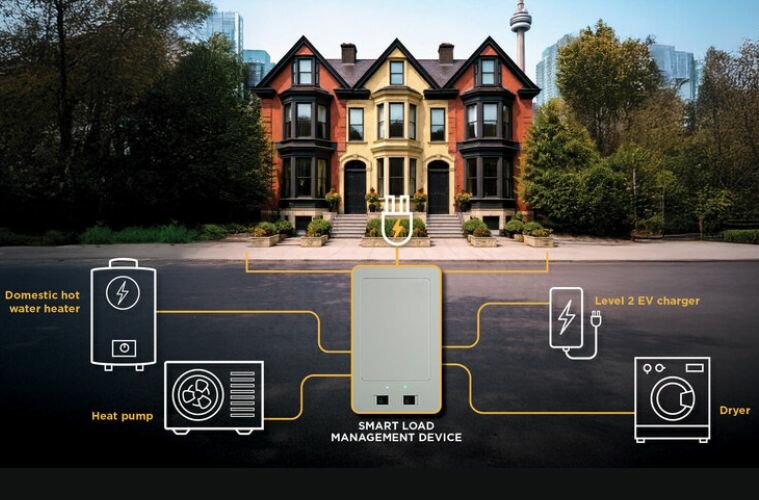
The utility announced this week the launch of Multiplex PowerPlay, a pilot program that will fund up to $50,000 per project toward smart load management systems for six multiplex housing developments across Toronto. Rather than requiring builders to upgrade to larger service capacity, the technology continuously monitors total building energy consumption and prevents demand from exceeding existing panel or service limits. The system balances load in real time, making room for electric heat pumps and EV chargers within infrastructure that was never designed to carry them.
It is a practical workaround for a constraint that is showing up in cities everywhere. In 2025 alone, Toronto Hydro received just over 100 service connection upgrade requests from multiplex buildings seeking 400-amp or larger service. That number reflects a broader trend: residential electrification is moving faster than the distribution infrastructure that supports it.
The Independent Electricity System Operator projects that electricity demand in Ontario will grow by 75% by 2050. Most of that growth will come not from large industrial loads but from the cumulative effect of millions of smaller decisions — a heat pump here, an EV charger there — made by homeowners and builders operating without a clear view of what the grid can actually absorb.
Smart load management systems are not a new concept, but deploying them at the multiplex scale as a funded pilot with the explicit goal of shaping policy is a different kind of initiative. Toronto Hydro is not just helping six builders avoid an expensive upgrade. It is generating the data and operational experience needed to know whether this approach can work across the broader housing stock.
Eligibility is specific. Projects must be located within Toronto's M postal code area, include four to six units such as garden and laneway suites, incorporate electrification technologies in the design, and have project plans that would otherwise require a 400-amp or larger service upgrade. Expressions of interest are open through May 31, 2026.
For developers and contractors working in urban infill and multiplex housing, the financial case is straightforward. Avoiding a major service upgrade removes a significant cost and schedule variable from projects that are already navigating tight margins and complex approvals. For facilities and energy professionals watching how cities manage the transition to electrified buildings, the more interesting question is what this pilot produces beyond the six projects themselves.
Toronto is not the only city where this math problem is getting harder to ignore. Grid connection delays, aging distribution infrastructure, and growing demand for EV-ready and heat-pump-ready buildings are converging in dense urban neighborhoods across North America. A replicable, utility-funded model for managing that load without triggering full service upgrades would be worth watching closely.
Related: What Boards Are Asking About Energy and Environmental Risk | How Regulatory and Market Uncertainty Is Changing Executive Risk Planning | Refinancing Risk Is Rising for Emissions-Intensive Companies


