
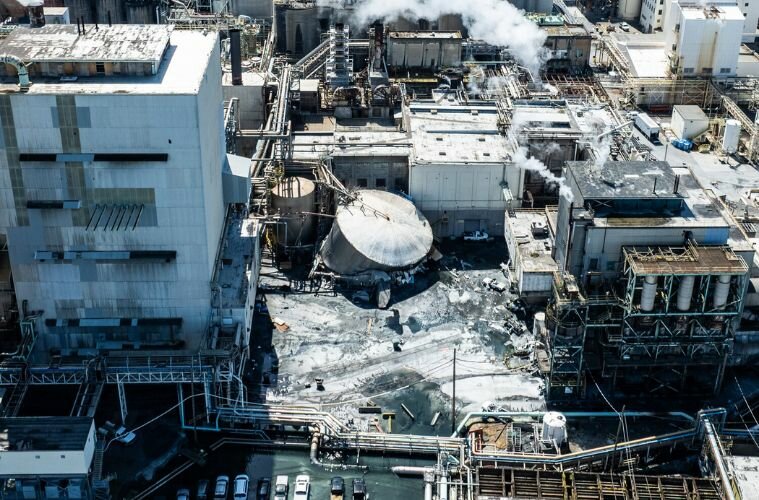
Just before 7:15 a.m. on May 26, a 900,000-gallon tank of white liquor at the Nippon Dynawave Packaging facility in Longview, Washington imploded. Up to 570,000 gallons of the highly caustic chemical solution, used to dissolve wood fiber during kraft paper production, flooded the mill floor and surrounding drainage systems during a shift change, when workers were gathered near the tank. Eleven employees were killed. Seven others suffered chemical burns and inhalation injuries. One firefighter was also injured responding to the scene.
Washington Governor Bob Ferguson described it as potentially the deadliest industrial tragedy in modern Washington state history. State officials confirmed it is the state's deadliest industrial disaster since 1930, when 17 miners died in a Carbonado explosion. All nine workers who were initially unaccounted for were recovered by Saturday, May 31. Two additional workers who had been transported to hospitals died from their injuries, bringing the confirmed total to 11.
White Liquor Composition and Why the Shift Change Timing Mattered
White liquor is a strongly alkaline mixture of sodium hydroxide (NaOH) and sodium sulfide (Na2S), a byproduct of the kraft pulping process used across the pulp and paper industry. Contact causes rapid chemical burns. Inhalation of vapors at high concentrations causes severe respiratory damage. The fact that the rupture happened at shift change, when incoming and outgoing crews are both typically present near operational equipment, is believed to have significantly increased the number of workers in the affected area at the time of the failure, according to KGW reporting.
Officials initially reported the tank's capacity at roughly 80,000 gallons. That figure was revised upward to 900,000 gallons after the scope of the spill became clear. Approximately 90,000 gallons remained inside the damaged structure after the rupture. The tank continued to pose structural hazards to recovery crews for days, requiring reinforcement before workers could safely re-enter the affected sections of the facility.
Two Open OSHA Complaints Were Already on File the Day the Tank Failed
The U.S. Chemical Safety and Hazard Investigation Board (CSB) opened a formal investigation on May 27, with investigators arriving on site that day. The Washington Department of Labor and Industries (L&I) has also deployed investigators, though the agency noted the formal investigation could not begin until recovery operations were complete, a process that took until May 31. The agency said the investigation could take up to six months.
What has already surfaced is a prior safety record that regulators and union officials are now examining closely. At the time of the May 26 implosion, two open Occupational Safety and Health Administration (OSHA) complaints were already active at the facility: one filed in March 2026 following an anonymous complaint about a valve on a tank holding aqua ammonia, and another filed May 6, 2026, related to a sinkhole caused by a failed drain, according to KOMO News. The Washington Department of Ecology had also issued a notice of penalty in March 2026 for air quality violations, fining the company $5,500 for venting process gases beyond permitted levels during the second half of 2024. A 2023 fire at the facility burned for several days, generating air quality advisories across southwest Washington and into Portland. L&I records show a citation in 2021 for a serious lockout/tagout violation, with a penalty of $2,700.
Whether any of those prior incidents are connected to the tank failure remains to be determined. The CSB has not indicated a probable cause. Nippon Dynawave's parent company, Japan-based Nippon Paper Industries, confirmed in a statement that the cause is under investigation and that the company is cooperating with all agencies involved. "These are our people," said Brian Wood, the company's director of support services, at a local press briefing. "We will cooperate to the fullest extent."
Environmental Contamination Reached Drainage Systems Near the Columbia River
White liquor spilled into drainage ditches adjacent to the facility following the rupture. The Washington Department of Ecology confirmed contamination entered the ditch system and that some material reached areas near the Columbia River. Officials were working to dilute the high-pH water in the affected ditches, and as of Monday, the Washington Department of Fish and Wildlife reported approximately 2,000 dead fish recovered from the ditch system. The drainage ditch sits above an aquifer that supplies Longview's drinking water. Officials said contaminated water was diverted away from the wellhead area and that the city's drinking water supply was not affected.
The mill, which operates on the Columbia River at 3401 Industrial Way in Longview, employs roughly 1,000 workers and has operated since Weyerhaeuser opened it in 1953. Nippon Paper acquired it in 2016. The facility produces bleached paperboard, tissue, printing paper, and liquid packaging materials. With the plant now shut down, the company told the union representing workers that employees would be paid through June 7, with an official determination on next steps to follow on or before that date.


