
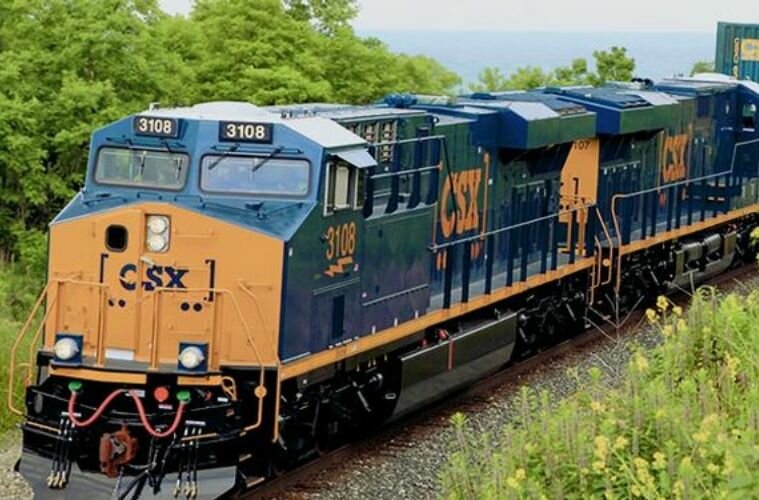
That strategy is at the center of a newly announced $670 million agreement between CSX and Wabtec Corporation, which will deliver a mix of new locomotives, modernized assets, and digital operating systems across CSX’s fleet.
Rather than relying solely on new equipment, the agreement blends 100 new Evolution Series locomotives, 50 modernized units, and advanced digital tools designed to extract more performance from existing rail infrastructure.
“Our locomotive fleet is a fundamental element of our safe and reliable railroad,” said Mike Cory, Executive Vice President and Chief Operating Officer at CSX. “Modernizing these critical assets strengthens network performance and supports the level of service our customers depend on.”
Rail infrastructure stress rarely shows up as a single point of failure. More often, it appears as degraded adhesion, overheating at low speeds, rising maintenance downtime, or reduced efficiency under heavier loads. These issues compound as networks age and freight volumes grow.
One of the most consequential upgrades in CSX’s plan is the conversion of aging D9 locomotives from DC to AC traction.
AC traction systems provide up to 100% greater adhesion than DC systems, allowing locomotives to pull heavier loads more consistently and operate at low speeds without overheating. From an infrastructure standpoint, this reduces stress on both rolling stock and the broader network by improving controllability and load distribution.
Technically, the conversion replaces DC traction motors and controllers with AC motors and inverter-driven systems, often paired with upgraded control platforms such as Wabtec’s FDL Advantage. The result is a locomotive that behaves more predictably under variable operating conditions—an increasingly important trait as rail corridors experience tighter capacity margins.
While the upgrades are driven by performance and reliability, the sustainability impacts are material.
Modernized locomotives are expected to be approximately 17% more fuel-efficient, reducing fuel consumption and associated emissions without requiring a wholesale shift in propulsion technology. For freight railroads, this kind of incremental efficiency gain is often more scalable—and more immediately deployable—than full fleet replacement.
AC traction motors also lack commutators and brushes, which means fewer moving parts, lower maintenance requirements, and higher reliability over time. Reduced maintenance frequency not only lowers operating costs but also minimizes service disruptions that ripple across supply chains.
The new and modernized locomotives will also be equipped with Trip Optimizer with Smart Horsepower per Ton, an EPA-certified digital system designed to dynamically manage power output and further improve fuel efficiency during operations.
CSX’s approach reflects a broader reality across infrastructure-heavy sectors: capacity constraints are increasingly being addressed through performance upgrades, not physical expansion.
By extending service life, standardizing fleet capabilities, and embedding digital intelligence, rail operators can extract more throughput and resilience from existing assets—often faster and at lower risk than building new infrastructure.
Deliveries of the new Evolution Series locomotives are expected to begin this year, with modernized units entering service starting in 2027.


