
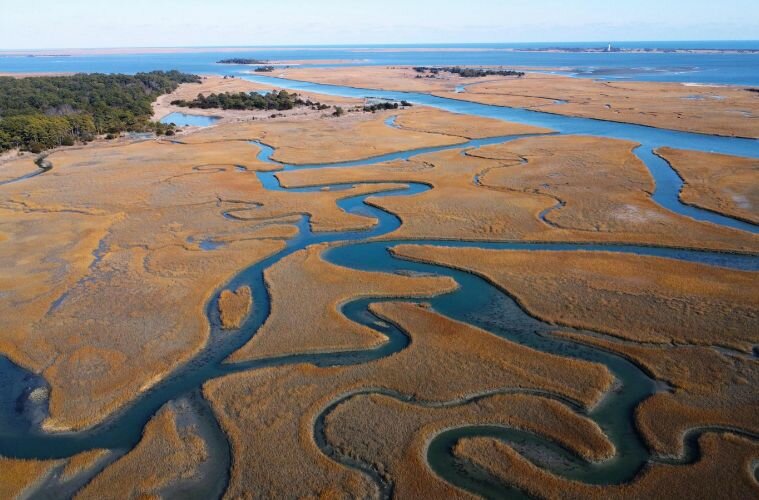
Nothing has been decided yet. That is worth saying plainly, because the Bureau of Ocean Energy Management (BOEM) Request for Information and Interest (RFI) published June 23 is an early-stage process step, not a lease award or even a decision to hold a lease sale. But it opens the door to something that has no precedent in U.S. history: commercial mining of the Atlantic Outer Continental Shelf (OCS). The RFI identifies an area between three and 63.5 miles off the Delmarva Peninsula, covering approximately 1.77 million acres just north of the mouth of the Chesapeake Bay.
Behind the RFI is a single company. Florida-based Odyssey Marine Exploration submitted an unsolicited lease request in November 2025 for more than 2,500 square miles of that same stretch of ocean, targeting heavy mineral sands and phosphorites. Congressional research suggests those deposits may be rich in titanium and other materials on the U.S. Geological Survey's list of 60 critical minerals. BOEM reviewed the application, signaled in December 2025 it would move forward, and published the RFI this week. Virginia is now one of four active seabed mineral leasing processes the Trump administration has opened under Executive Order 14285, alongside efforts off American Samoa, the Commonwealth of the Northern Mariana Islands, and Alaska. None of those have produced a lease yet either.
What the RFI Area Covers and What the Leasing Process Looks Like
The RFI area spans water depths of roughly 30 to 410 feet, lying entirely on the continental shelf. BOEM is asking stakeholders for information on geological conditions, environmental and biological resources, fisheries use, shipping and navigation conflicts, and socioeconomic data from potentially affected communities. Companies interested in specific blocks can submit indications of interest directly to BOEM; those indications are treated as proprietary and will not be publicly associated with the submitting party.
Even under an accelerated timeline, what comes next is a long road. Area identification, environmental analysis under the National Environmental Policy Act (NEPA), a Proposed Leasing Notice, and a Final Leasing Notice all have to happen before a single bid is accepted. BOEM has been careful to characterize the earliest exploration activities as limited in scope: bathymetric and geological surveys, no permanent structures, the kind of work that beach nourishment projects have used in these same waters for years. Whether that framing holds once industrial extraction enters the picture is a different question, and one the agency has not yet had to answer anywhere on the Atlantic shelf.
The Fisheries and Coastal Conflict the RFI Has to Resolve
The area BOEM is evaluating is not empty ocean. Virginia's commercial fisheries rank third in U.S. landings, with dockside value exceeding $266 million annually and broader supply chain activity topping $1 billion, according to the Southern Environmental Law Center (SELC), which announced it would oppose the leasing effort. The region also hosts the largest concentration of naval operations in the world, including submarine operations, air combat training, and missile defense testing, as well as Wallops Flight Facility, a NASA rocket launch site. BOEM is required to consult with the U.S. Fish and Wildlife Service, the National Oceanic and Atmospheric Administration (NOAA), the U.S. Army Corps of Engineers, and the Mid-Atlantic Regional Council on the Ocean, among other agencies, before making any leasing decision. Tribal consultation is also required under the Department of the Interior's consultation policy.
Industrial-scale seabed dredging of the kind Odyssey Marine Exploration would require could generate sediment plumes extending well beyond the mining footprint, with potential effects on marine habitat, fisheries, and coastline stability that regulators have not yet fully assessed for Atlantic conditions. BOEM has produced preliminary maps of where critical minerals may exist on the OCS, but the agency acknowledges that the environmental baseline data needed to evaluate extraction impacts is still being developed. The RFI is partly an attempt to gather that information before any decisions are made.


