
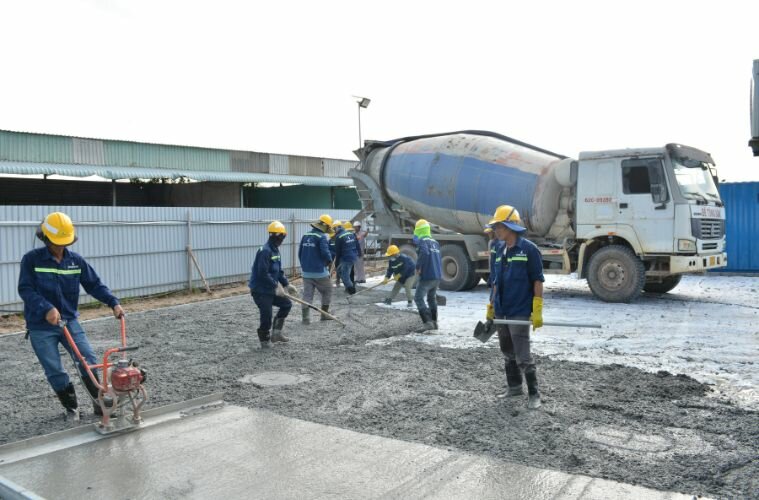
The skilled trades shortage that has been building for a decade accelerated into something qualitatively different in 2025 and 2026. Multiple sectors requiring the same highly specialized workers — data center commissioning agents, high-voltage electricians, pipefitters, linemen — are now competing head-to-head in the same regional labor markets on overlapping construction schedules. Procurement teams built to optimize cost and contract terms are finding that the first question has shifted. It isn't who is cheapest or most experienced. It's who can actually staff the project.
That's a harder problem than it looks, and it doesn't yield to the tools procurement functions traditionally use. Raising the budget, widening the bid pool, or tightening the schedule doesn't fix a workforce shortage. It surfaces it faster.
A Workforce Gap That Wages and Urgency Alone Cannot Close
The Associated General Contractors of America (AGC) estimates the U.S. construction sector needs approximately 349,000 net new workers in 2026 to meet current demand — a figure that accounts for retirements, attrition, and active project backlogs. Deloitte's 2026 Engineering and Construction Industry Outlook puts the longer-term number at a potential shortage of more than two million skilled craft professionals by 2028 if current trends hold. That projection accounts for an aging workforce, a constrained pipeline of younger entrants, and shifting skill requirements as jobsites increasingly integrate automation controls, smart building systems, and digital monitoring alongside traditional trades.
The obvious response — pay more — is already underway and insufficient. Construction wages have grown faster than the broader economy since 2020. Contractors are offering signing bonuses, retention packages, and accelerated advancement paths. The shortage persists anyway, for reasons that are structural rather than transactional. Training a journeyman electrician takes years regardless of wage rates. Workers don't relocate at scale to match project geography, even with relocation incentives. Immigration policy also shapes the available labor pool in ways no contractor or procurement function controls. According to the U.S. Bureau of Labor Statistics (BLS), construction and extraction occupations account for 14.5% of employed foreign-born workers, compared with 6.4% of employed native-born workers. This concentration has driven immigrants to make up nearly 30% of the overall construction workforce—reflecting how heavily the industry has come to depend on immigrant labor for trades that are already in short supply.
Why Data Centers, Grid Infrastructure, and Clean Energy Are Competing for the Same Crews
The structural labor gap is being compounded by what construction analysts have called a 2026-to-2030 collision: data centers, grid transmission upgrades, clean energy installations, and semiconductor fabrication plants are all accelerating simultaneously, and they all require the same specialized trades in the same regional markets. JLL's 2026 Global Data Center Outlook projects the sector could add roughly 97 gigawatts (GW) of capacity between 2025 and 2030, an investment of potentially $3 trillion. That capital cannot convert into delivered capacity without high-voltage crews, commissioning specialists, and mechanical contractors. In the current market, those aren't a uniform pool. A region can have general construction activity and still lack the specific teams needed for a high-density AI campus or a major substation upgrade.
Analysis from Bluebeam states that raising wages helps but cannot overcome time, geography, and policy. Apprenticeships still take years to produce field-ready workers. Specialized trades can't instantly relocate to every congested market. And the regulatory environment governing immigration — which shapes the available labor pool — isn't something project timelines wait for. The result is what the analysis describes as an efficiency mandate rather than a hiring solution: extracting more capacity from the workforce that exists, because the workforce needed doesn't yet.
What this means for procurement is that it isn't competing with other buyers in its own sector. A grid infrastructure procurement team is competing with hyperscale data center developers and semiconductor fab contractors, often in the same geography, often on schedules that were all approved in the same capital planning cycle. Outbidding the competition doesn't solve this when the pool of qualified contractors for critical scopes is already thin.
How Contract Structure Is Adapting to Labor as the Limiting Variable
When workforce availability becomes the primary project constraint, the behaviors that produce results in procurement look different from those that work in a cost-competitive or demand-scarce environment. Competitive bidding across a wide contractor pool works when the pool is deep. When it isn't, leverage moves earlier: into contractor relationships, early scope engagement, and pre-qualification criteria that assess labor depth alongside technical capability and pricing.
Contract language is adapting to reflect this. Escalation clauses, which pass documented labor cost increases through to the project owner, are becoming standard on energy and infrastructure projects, according to Deloitte's 2026 industry analysis. Early release packages — where portions of scope are awarded ahead of full contract execution to lock in material and crew commitments — are being used specifically to reduce the risk that a qualified contractor's available teams have been committed elsewhere by the time the primary contract signs. Prefabrication of mechanical and electrical assemblies is gaining traction because it shifts work from geographically constrained field labor to factory settings where workforce management is more controllable. Each of these is a response to the same condition: the traditional assumption that a qualified contractor can staff to schedule no longer holds across all scopes and markets.
The Procurement Posture That Fits the Current Market
The effective leverage point for procurement in this environment is earlier than the sourcing stage. By the time a project hits formal solicitation, the contractor's workforce is already committed to other work or available to bid — and that availability is determined by market conditions procurement didn't create. Teams that arrive at the sourcing stage without having assessed regional labor depth, competing project activity, and contractor workforce capacity are building project schedules against assumptions that may not hold.
Early market sounding — informal engagement with contractors before formal solicitation — surfaces labor realities that formal bid responses often smooth over. Labor availability deserves to be treated as a scheduling variable alongside equipment lead times and interconnection timelines, not as an assumed background condition. Projects that require specialists in high-demand categories should carry a contingency structure that addresses what happens if the primary contractor can't staff to schedule, because in 2026, that outcome is realistic rather than extreme.
Procurement didn't produce the workforce conditions that are reshaping project delivery. It is, however, where those conditions most directly meet commitments. The function that accounts for labor availability before projects are scoped and scheduled is the one best positioned to close them on time.


