
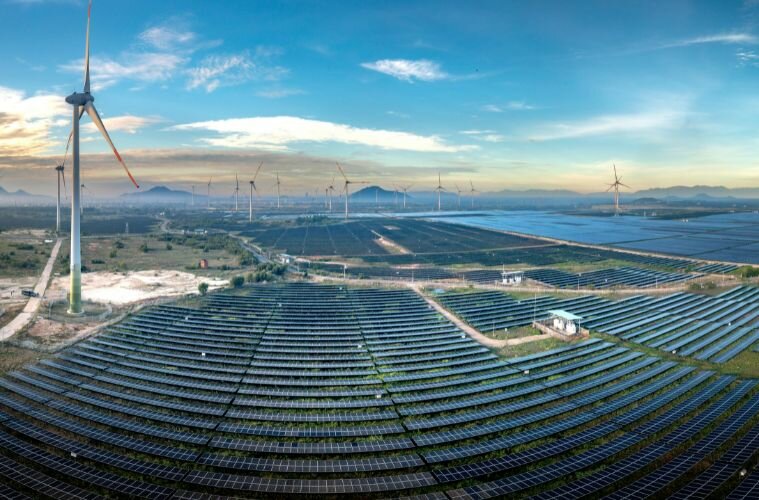
Vietnam's Revised 8th Power Development Plan (PDP8R) puts a number on that bet: roughly $62 billion in transmission investment through 2050, with $18 billion of it targeted for 2026 through 2030 alone. That spending is not chasing existing load. Vietnam's grid has historically lagged its own generation buildout badly enough that transmission bottlenecks stranded a meaningful share of installed capacity and forced the country to import 2.56 billion kilowatt-hours of electricity from China in 2024, even as renewable generation elsewhere in the country was curtailed because transmission constraints prevented it from reaching demand. The new plan aims to avoid a repeat of that mismatch by expanding transmission in anticipation of the industrial growth the government hopes to attract, rather than reacting to it after fabs are already committed.
The reason grid readiness matters this much to semiconductor investment specifically is power intensity. Advanced logic and memory fabs can require hundreds of megawatts of reliable, high-quality power, and advanced packaging facilities and AI data centers increasingly compete for that same transmission capacity in the same industrial corridors. For a chipmaker or packaging operator evaluating where to locate the next facility, grid readiness now sits alongside labor availability, water access, incentives, and permitting as a core site-selection factor, not a downstream engineering detail to work out after the location is chosen.
Vietnam Is Wiring a Grid Around an Industry It's Still Building
Vietnam's semiconductor sector was valued at $18.23 billion in 2024 and is expanding at close to 11.5% annually, according to industry market research, as the country promotes its ambition to become a regional semiconductor hub, a strategy sometimes described by industry observers as a "Silicon Delta." To support that ambition, Vietnam amended its Electricity Law and public-private partnership rules to expand opportunities for private and foreign investment in transmission infrastructure, a structural change aimed at moving faster than the state utility alone could finance, even as the state retains significant control over the sector. A new 500-kilovolt corridor between Lào Cai and Vĩnh Yên, a $300 million line capable of moving 3,000 megawatts (MW) of northern hydropower, went live in September 2025 as an early test of that approach. The plan envisions total power capacity near 146,000 MW by 2030 and more than 416,000 MW by 2045, a long-term vision rather than a guaranteed build schedule, and one that assumes industrial demand will show up roughly on the timeline the plan anticipates.
That assumption carries real execution risk. Vietnamese government data show only two of sixteen mandated grid projects met their 2024 timelines, and roughly $13 billion in wind and solar assets are currently at risk after auditors found misapplied feed-in tariff rules, prompting several international developers to exit projects entirely. Grid-first industrial policy only works if the grid actually gets built on the schedule the policy assumes, and Vietnam's own recent record on that point is mixed.
Malaysia Is Sequencing Interconnection Ahead of the Investment Case
Malaysia is running a version of the same strategy through its Ministry of Energy Transition and Water Transformation, which published a five-year strategic plan for 2026 through 2030 built around grid resilience, market reform, and cross-border interconnection. The plan calls for new high-voltage links connecting Peninsular Malaysia with Singapore, Thailand, and Vietnam, alongside a rollout of roughly 800,000 smart meters annually through 2028. On the industrial side, Malaysia's National Semiconductor Strategy is pushing the country up the value chain from basic assembly toward advanced packaging, silicon carbide production, and power semiconductor manufacturing, the same segments where utilities elsewhere are learning that securing capacity years ahead of confirmed demand is now the safer bet than waiting for a signed customer first. The grid investment and the industrial strategy are being built as a single package rather than as sequential decisions, which is the opposite of how most Western grid planning still works.
The Regional Grid Is the Actual Investment Thesis
Both national strategies feed into a larger regional bet: the ASEAN Power Grid, which has drawn financing commitments of up to $10 billion from the Asian Development Bank and $2.5 billion from the World Bank. The International Energy Agency has found that electricity demand across Southeast Asia grew at twice the global average rate in 2024, with consumption expected to double by 2050, while the region's technical renewable potential sits near 20 terawatts, roughly 55x its current generation capacity. The strategic logic is that no single country's grid needs to solve its own capacity problem alone if the region builds enough cross-border capacity to share it, an approach that resembles how European operators facing their own generation-rich, transmission-poor mismatch have started treating flexibility as the actual constraint to solve for, not raw generating capacity.
What This Means for Site Selection Decisions Right Now
For technology companies evaluating Southeast Asia for a new fab, packaging facility, or AI data center campus, the calculus is different from the site selection math that applies in the United States or Europe. Grid capacity is being built as a deliberate industrial recruitment tool rather than negotiated project by project after a company commits, which has the potential to shorten the traditional multi-year wait for transmission access that has become standard elsewhere, provided the underlying projects stay on schedule. That is the open question, not the ambition. Vietnam's own execution record on grid timelines, and the broader pattern of policy volatility that has already pushed some renewable developers out of the market, means companies should treat published capacity targets as a policy intention to verify against actual project milestones, in the same way power, water, permitting, and capital have converged into a single planning variable for large projects everywhere else, rather than a delivery date to plan a fab opening around.


