

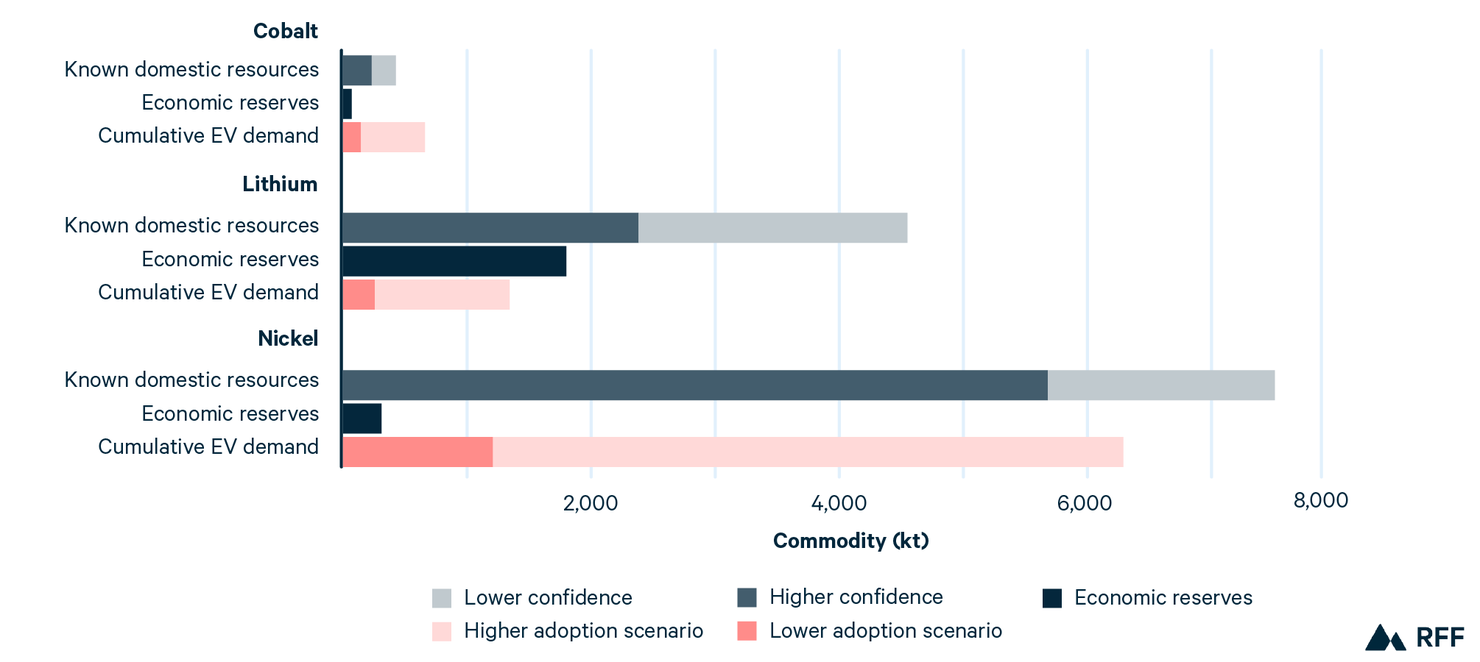
Critical minerals are foundational to energy storage, clean manufacturing, and defense systems. Yet according to the U.S. Geological Survey (USGS), domestic output in 2024 represented just 2% of global lithium, 0.22% of nickel, and 0.10% of cobalt. Lead times for new mines can exceed two decades, making rapid onshoring economically and technically infeasible.
“Even if additional resources are discovered, the national interest in resilient mineral supply chains is best served by cultivating trade contracts with friendly and reliable countries,” the report concludes.
The United States has increasingly relied on tariffs, executive orders, and defense-led partnerships to secure domestic production. Recent federal actions include a 160% tariff on Chinese graphite and multibillion-dollar initiatives to expand rare-earth magnet production with MP Materials.
But the RFF analysis warns that this resource nationalist approach carries diminishing returns. China currently processes over 60% of global cobalt, lithium, and manganese, maintaining a cost advantage built on decades of industrial policy. Attempts to replicate that model domestically would require an estimated $70 billion or more in capital spending for refining infrastructure alone—without solving the deeper problem of geological scarcity.
Instead of full autarky, RFF calls for “structured international cooperation with selective domestic expansion.” The framework emphasizes long-term partnerships with mineral-rich, politically stable allies through mechanisms like the Minerals Security Partnership (MSP) and the U.S.–EU Metals Alliance.
These alliances could distribute the cost of refining and processing capacity while establishing shared environmental and transparency standards. Japan’s rare-earth diversification strategy offers a clear precedent—reducing Chinese dependency from 90% to 60% within a decade through targeted bilateral deals and recycling programs.
Such models demonstrate that supply chain resilience depends on trust and transparency, not territorial control.
Building refining capacity for nickel, cobalt, and lithium within U.S. borders would be an immense undertaking. RFF estimates that:
Even with those investments, U.S. facilities would struggle to match Chinese economies of scale or the integrated logistics that make Chinese refining globally dominant. Without coordinated subsidies or unified pricing agreements among allied economies, American producers would face steep cost disadvantages.
The report reframes resilience as an international enterprise, not a nationalist one. A secure mineral ecosystem requires cross-border integration, diversified processing networks, and transparent trade rules that prevent market manipulation.
This collaborative approach also aligns with the decarbonization and circular-economy priorities embedded in earlier U.S. energy policy frameworks, such as the Inflation Reduction Act’s demand-side incentives. RFF cautions that pivoting toward isolationist strategies—centered on tariffs and deregulation—may undercut both market stability and sustainability goals.
Resource nationalism may sound like self-reliance, but in practice, it can mean vulnerability. For minerals vital to EV batteries, semiconductors, and renewable infrastructure, no single nation can achieve security alone.
RFF’s findings suggest that the United States should pair selective domestic investment with robust international cooperation, ensuring that the energy transition is supported by resilient, transparent, and environmentally responsible mineral supply chains.


