

New analysis indicates that recycled polyester may worsen microplastic pollution, complicate product safety and exposure considerations, and introduce mounting green-claims risk—particularly as regulators and watchdogs sharpen expectations around substantiation and transparency. For companies operating global apparel and textile supply chains, recycled polyester is shifting from a default “preferred fiber” to a material that demands far more rigorous oversight.
Synthetic fibers dominate modern textiles. Polyester alone accounts for the majority of global fiber production, and recycled polyester has become a cornerstone of brand sustainability strategies. Yet, most recycled polyester does not come from textile-to-textile recycling. Instead, it is primarily derived from plastic bottles, redirecting packaging waste into apparel rather than closing the loop within the textile system.
That distinction matters. Bottle-to-fiber conversion may reduce certain waste streams, but it does not address overproduction of synthetic textiles, nor does it prevent microfiber shedding during manufacturing, use, or disposal. In effect, recycled polyester often functions as downcycling rather than true circularity—while still being marketed as a climate- and pollution-friendly solution.
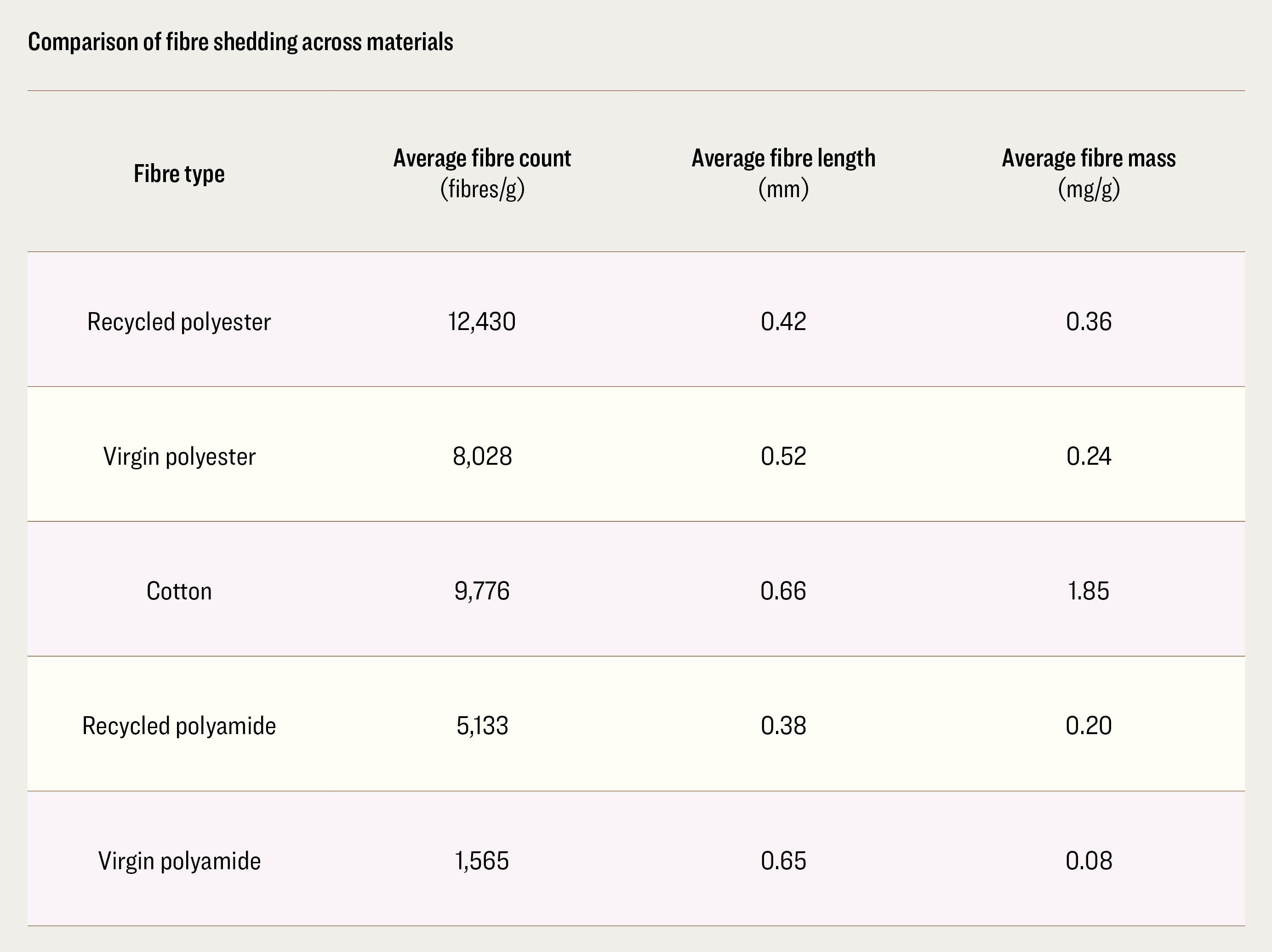
Testing and lifecycle assessments increasingly show that recycled polyester can shed more microfibers—and finer particles—than its virgin counterpart. These fibers are released during production, routine washing, and end-of-life processing. A single wash cycle can release hundreds of thousands of synthetic fibers, many of which bypass wastewater treatment systems and persist in the environment.
What elevates this from an environmental concern to a business risk is the expanding evidence of human exposure. Microplastics have now been detected in air, water, food, and human tissue. While regulatory thresholds are still evolving, the direction of travel is clear: microfiber pollution is no longer viewed solely as an ocean or wildlife issue. It is increasingly discussed in the context of health, exposure, and product responsibility.
Beyond environmental performance, recycled polyester introduces a second, more immediate risk: claims integrity.
Audits of product listings, packaging, and physical labels have revealed inconsistencies between how garments are marketed online and how they are labeled at point of sale. In some cases, items promoted as containing recycled materials were labeled simply as “polyester,” or shifted descriptions over time. These discrepancies may appear minor, but they are precisely the type of misalignment regulators and plaintiffs increasingly target in greenwashing cases.
As enforcement tightens across the U.S., EU, and other major markets, recycled content claims now require the same rigor as financial disclosures. Brands that cannot substantiate recycled percentages, sourcing pathways, and material performance across channels risk regulatory scrutiny, legal exposure, and reputational damage.
For procurement and sourcing teams, recycled polyester has often been a convenient compliance lever—meeting internal sustainability targets without disrupting supplier relationships or cost structures. That convenience is eroding.
Key risk signals now include:
In practice, this means recycled polyester can no longer be treated as a blanket improvement over virgin synthetics. It must be evaluated alongside durability, shedding performance, end-of-life outcomes, and claims defensibility.
Regulators are increasingly signaling that downstream mitigation alone—such as filters, capture technologies, or consumer guidance—will not be sufficient. Policy discussions are shifting toward source reduction, design responsibility, and limits on synthetic fiber proliferation.
Emerging frameworks in Europe and international negotiations on plastics point toward:
For multinational brands, this means today’s sourcing decisions may be judged against tomorrow’s standards.
Recycled polyester is not disappearing, but its role is changing. Companies that continue to rely on it should adjust governance accordingly.
Priority actions include:
The central takeaway is not that recycled polyester is inherently bad—but that it is no longer a free pass. As scrutiny intensifies, the material sits at the intersection of environmental performance, health considerations, and claims credibility.
For brands and agencies looking to reach the decision-makers who read E+E Leader:
Request the media kit and learn more about advertising and partnership opportunities.


