
For most of the past decade, the conversation about on-site generation in a corporate facilities context began with sustainability. Solar panels on the roof were a visible commitment to emissions reduction. Battery storage was a hedge on a carbon-free future. The business case was often secondary to the signal, and that was acceptable because the cost economics didn't always support the investment on purely financial terms.
Both the economics and the strategic logic have shifted simultaneously in 2026, and that convergence is accelerating how seriously facilities and energy leaders are approaching on-site generation decisions.
How Commercial Solar and Battery Storage Costs Have Changed the On-Site Generation Business Case
The cost of commercial-scale solar has declined by more than 80% over the past decade. Battery storage costs have followed a similar trajectory. According to the National Renewable Energy Laboratory's (NREL) most recent analysis, the levelized cost of energy from a commercial rooftop solar installation in most U.S. markets is now below retail electricity rates, in many cases meaningfully so. That is a different financial conversation than the one this industry was having in 2018.
What's layered on top of those economics is the rising cost of grid electricity in markets experiencing capacity constraints. When peak demand pricing, capacity charges, and demand response penalties are factored into the full cost of grid-sourced power for a large commercial or industrial facility, the comparison point against which on-site generation is evaluated has moved higher. In constrained markets, the gap between on-site generation cost and grid power cost is now larger than it has been at any prior point.
Why Grid Reliability Risk Is Now the Primary Driver of On-Site Generation Investment
The economics are favorable. But the risk logic is what's driving urgency in the current environment.
A facility entirely dependent on the grid is exposed to every disruption, constraint, and reliability event in the grid it connects to. During the heat events, winter storms, and unexpected peak demand periods that have become more frequent, that exposure has real operational consequences. A manufacturing facility that loses power for four hours during a peak event may absorb hundreds of thousands of dollars in lost production, restart costs, and supply chain disruption.
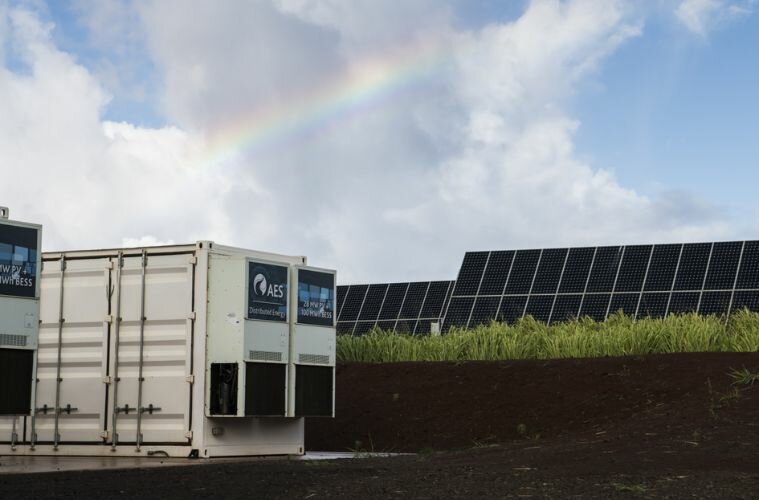
On-site generation paired with battery storage changes that exposure profile. A facility with sufficient on-site capacity to cover critical loads during a grid event does not eliminate grid dependence, but it materially reduces the tail-risk exposure that comes with 100% reliance on external supply. That shift is becoming more visible in market data. Wood Mackenzie and the American Clean Power Association report that the U.S. installed a record 18.9 GW of battery energy storage across utility, commercial and industrial, and residential segments in 2025—a 52% increase over 2024 levels.
Within the community, commercial, and industrial segment, installations reached 191 MW in 2025, with Wood Mackenzie projecting the segment to grow another 23% from 2025 to 2029. Adoption remains most concentrated in regions facing the highest reliability pressure, volatile peak pricing, and interconnection constraints—an indication that resilience and operational continuity, not just sustainability targets, are increasingly driving investment decisions.
How On-Site Generation Provides an Alternative Path When Interconnection Queues Run Long
There's a second dimension of the risk management case that gets less attention: on-site generation's interaction with interconnection timelines. In markets where new or expanded grid connections face multi-year delays, on-site generation provides a path to operational energy capacity that doesn't require navigating the utility interconnection queue. A facility that can deploy rooftop solar, battery storage, and potentially small-scale combined heat and power to cover a meaningful share of its operational load has options that a fully grid-dependent facility simply doesn't have in a constrained market.
This is particularly relevant for facilities in expansion or build-out phases, where the ability to energize operations incrementally, using on-site resources while the utility's larger infrastructure investment is completed, can preserve project timelines and reduce the financial exposure from delayed full-power interconnection.
How Reframing On-Site Generation as Risk Management Gets Projects Approved Internally
The facilities leaders moving most decisively on on-site generation right now are not framing it as a sustainability capital expenditure decision. They're framing it as an operational resilience investment, evaluated against the cost of grid-dependent operational risk and the timeline of waiting for utility-delivered capacity.
That reframe changes the internal approval conversation. A CFO who is skeptical of sustainability capex may be quite receptive to a risk management investment with a quantified exposure reduction case and a favorable payback period relative to grid alternatives. The underlying project is identical. The framing that gets it funded is different, and in the current environment, that framing is increasingly the accurate one.


