
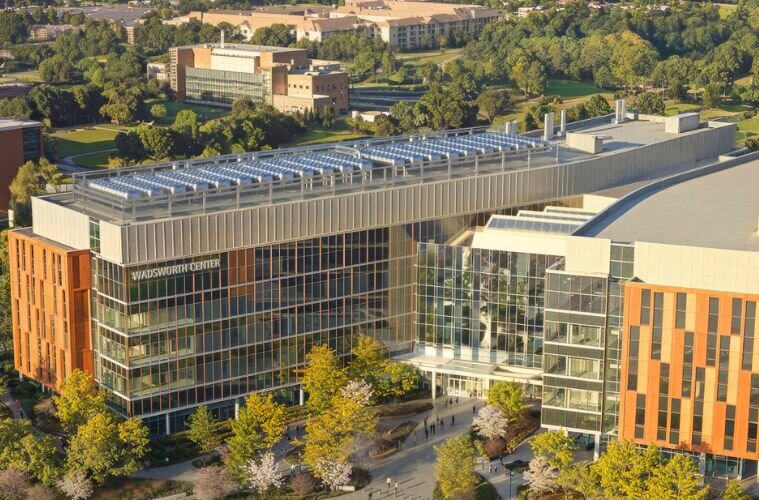
Governor Kathy Hochul announced that construction is underway on a new facility for the Wadsworth Center, the laboratory arm of the New York State Department of Health. The project will consolidate five existing laboratory sites across the Albany region into a single, purpose-built campus on the Harriman Campus, with completion targeted for 2030.
At more than 660,000 square feet and housing nearly 800 staff, the new laboratory is expected to become one of the largest and most advanced state-run public health labs in the United States.
The decision to centralize Wadsworth’s operations reflects a broader shift in how public-sector institutions are addressing operational risk. Fragmented facilities—while flexible in theory—have proven difficult to scale, modernize, and secure during periods of stress, particularly when advanced diagnostics, biosurveillance, and environmental testing must operate continuously.
By consolidating facilities, New York aims to streamline workflows, modernize laboratory systems, and improve coordination across testing programs that range from infectious disease surveillance to environmental health and newborn screening.
State officials have emphasized that the new facility is being designed for adaptability over multiple decades, allowing laboratory configurations and equipment to evolve alongside emerging public health threats and advances in biomedical technology.
While the project is framed publicly around preparedness and scientific leadership, it also carries important implications for laboratory supply chains and infrastructure planning.
A single, centralized facility concentrates demand for:
This concentration can improve efficiency and standardization, but it also raises the stakes for continuity planning. Any disruption—construction delays, equipment procurement issues, or commissioning challenges—has systemwide consequences once operations are fully consolidated.
For suppliers and service providers, the scale of the Wadsworth project signals sustained, long-term demand, but also tighter coordination requirements and higher expectations for reliability.
The laboratory is being delivered through a design-build partnership between Gilbane Building Company, Turner Construction Company, and HOK, under the oversight of the Dormitory Authority of the State of New York.
With a planned delivery timeline extending to 2030, the project sits at the intersection of rising construction costs, evolving building standards, and changing technology requirements. Long-duration public infrastructure projects increasingly face the challenge of building facilities that must remain relevant despite rapid advances in automation, diagnostics, and data integration.
To address this, the state has indicated that the laboratory will emphasize modularity, energy efficiency, and sustainable design—features intended to reduce long-term operating risk and lifecycle costs.
Wadsworth’s expansion comes as public health laboratories nationwide reassess capacity after years of strain from pandemic response, wastewater surveillance expansion, and growing environmental monitoring demands. Many states continue to rely on aging, distributed facilities that are costly to maintain and difficult to upgrade.
New York’s approach—large-scale consolidation backed by significant capital investment—may serve as a reference point for other jurisdictions weighing how to modernize public health infrastructure while balancing resilience, cost, and operational complexity.
The project also underscores how preparedness is increasingly tied not just to staffing and policy, but to physical infrastructure decisions that shape supply chains, energy use, and long-term execution risk.


