

Since Operation Epic Fury began in early March 2026, strikes have hit port infrastructure in Abu Dhabi, Dubai, Jabal Ali, and Manama. At least 12 merchant vessels have been struck in Gulf ports or in open water. Electromagnetic jamming across the region is disrupting vessel navigation and communication, raising collision risk even for ships not directly targeted. By March 9th, the Strait of Hormuz — through which roughly 150 crude and LNG tankers were anchored at the conflict's outset — had been effectively blockaded, with only vessels carrying Iranian connections reported to be transiting.
Qatar has suspended LNG production, a shutdown that energy analysts warn could take months to restore to full capacity. Saudi Arabia's Ras Tanura refinery was struck on March 2nd — one of the largest crude processing facilities in the world. The UAE's Fujairah Port took a hit the following day. Iraq, Israel, and Kuwait have all reported energy production impacts. Saudi Arabia is rerouting some crude exports via the Red Sea, but that workaround has real capacity limits and its own security risks.
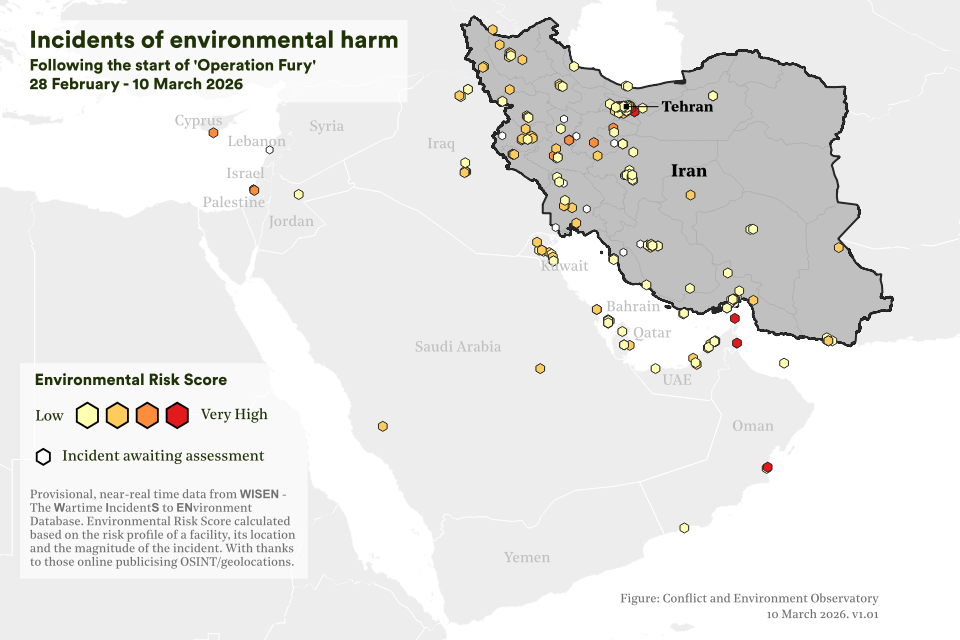
The Conflict and Environment Observatory (CEOBS), tracking incidents since the conflict began, has documented over 300 environmentally relevant incidents as of March 10th. Fossil fuel infrastructure accounts for a significant share of the highest-risk events. Attacked oil storage and refinery sites release particulate matter, nitrogen oxides, sulfur dioxide, and toxic organic compounds including PAHs — all of which carry downwind health risks and long-term soil and water contamination concerns. Damaged military and port facilities add fuels, heavy metals, and PFAS to that picture.
The marine dimension is also widening. The Iranian frigate Dena, torpedoed near Sri Lanka, left a 20-kilometer oil slick now threatening protected coastal ecosystems. Sunken vessels in Gulf ports present ongoing contamination risks from fuels and oils — risks that are difficult to assess while active conflict limits access for emergency response teams.
Global urea trade is disrupted — a direct hit to agricultural supply chains dependent on Gulf production. Vessel insurance costs have spiked, functioning as a secondary blockade layer on top of the military one. For companies with spot energy contracts or fuel-linked logistics agreements, the cost exposure is real and immediate.
The Trump administration signaled on March 9th that the conflict may be winding toward a close. But LNG restoration, tanker repositioning, and physical port repair don't reset overnight. Some of this infrastructure damage will take months to work through — and that timeline doesn't wait for a ceasefire announcement.
Organizations with Gulf-sourced energy, LNG contracts, or freight routing through Hormuz should be actively pressure-testing their contract structures and identifying where their next 60–90 days of exposure actually sits. The window to get ahead of it is narrowing.


