
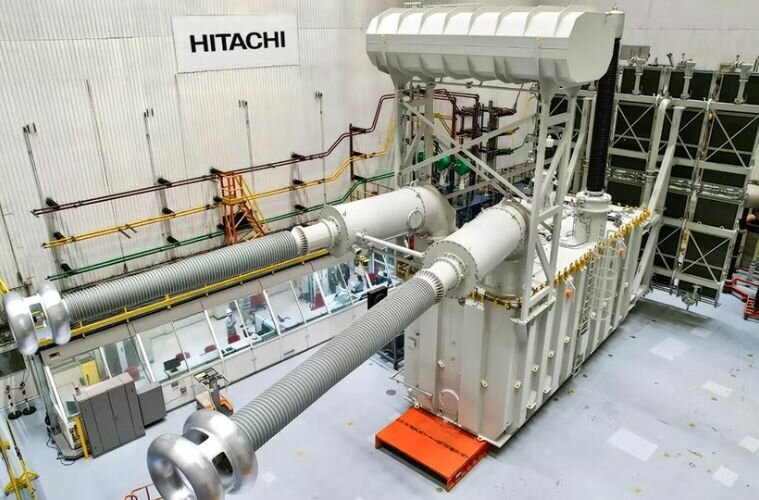
Demand for generation step-up transformers, the large units that connect new power plants to the grid, climbed 274% between 2019 and 2025, according to Wood Mackenzie data. Average lead times for that equipment reached 143 weeks in the second quarter of 2025, with standard power transformers running close behind at 128 weeks. Hitachi Energy, one of the sector's largest suppliers, has separately described the current stretch of demand as unprecedented and backed that assessment with a $1.5 billion global manufacturing investment plan announced in 2024. Those figures describe a shortage severe enough to delay power plants, data centers, and industrial expansions regardless of how much capital a company is willing to spend, a dynamic already visible in how manufacturers and data center developers compete directly for scarce grid capacity and equipment inside the United States, because the constraint sits upstream in a manufacturing base that took decades to shrink and cannot be rebuilt overnight. Manufacturers in three countries are now responding with investment large enough to look less like routine capacity additions and more like a bet that domestic transformer production is becoming permanent national infrastructure.
South Korea Is Doubling Down on What It Already Builds Well
South Korea entered this shortage with an advantage: its manufacturers already supply a meaningful share of the extra-high-voltage transformers sold into the U.S. market. HD Hyundai Electric broke ground in March on a second plant at its Montgomery, Alabama production site, a roughly $200 million investment that will increase the company's extra-high-voltage transformer capacity by 50% and add manufacturing and testing capability for 765-kilovolt-class units when it is completed in April 2027. LS Electric, a competing Korean manufacturer, signed a $312 million contract this year to supply transformers to a renewable energy power plant that will serve as a key electricity source for a large data center under construction in the southeastern United States, with deliveries scheduled between 2027 and 2029. Neither company is chasing a short-term order backlog. Both are committing capital years out, aimed at a market they expect to stay tight well past this shortage cycle.
Brazil Is Building Capacity to Match Its Own Grid Plan
Brazil's push has a domestic anchor, though the manufacturing investment behind it is corporate rather than state-funded. Hitachi Energy announced an investment of more than $200 million in 2024 to expand its Guarulhos transformer factory and build a new greenfield plant in Pindamonhangaba, both in São Paulo state, a project the company says will roughly double its production capacity in the country by 2028. In March 2026, Hitachi Energy layered on an additional $150 million across Latin America, with $70 million going toward accelerating the Brazilian expansion and $80 million toward its Dosquebradas transformer factory in Colombia. Brazil's own grid buildout, outlined in its PDE 2034 energy plan, is the demand signal manufacturers are building against, though the specific transmission and substation capacity figures attached to that plan should be confirmed against Brazil's official planning documents rather than secondary summaries before being treated as settled. What is well documented is that Brazil has also become a significant transformer exporter to the United States, one of a handful of countries, alongside Mexico, Canada, and South Korea, that supply the bulk of U.S. power transformer imports.
India Is Building Capacity With Its Government as a Partner
India's expansion is the one case here that goes beyond a corporate bet on a favorable market. Toshiba Transmission and Distribution Systems (India) is investing more than 562 crore rupees, roughly $70 million, to expand its Telangana manufacturing base, raising annual power transformer production capacity from 30,000 to 42,000 megavolt-amperes, a 40% increase. That expansion was formalized through a memorandum of understanding with the Telangana state government, making it a rarer example of a government directly co-signing a manufacturing commitment rather than simply benefiting from one. India's broader grid buildout supports the same thesis: the country continues to expand high-capacity transmission out of renewable energy zones like Khavda in Gujarat, including lines built by Adani Transmission subsidiaries to move several gigawatts of power at 765 kilovolts, and industry analysts describe India as an increasingly fast-growing transformer export base, though comprehensive trade data comparing India's growth rate against competing manufacturing countries is not yet consolidated in public reporting.
Tariffs Add Friction to a Market the U.S. Depends On
The United States announced 25% tariffs on most imports from Brazil on July 15, effective July 22, following a Section 301 investigation into what U.S. trade officials characterized as unfair trade practices. The order exempts several categories, including coffee, beef, citrus products, some energy goods, and aerospace parts and components, and it is not yet confirmed whether transformers or other grid equipment fall inside or outside that exemption list. Separately, the U.S. imposed a 50% tariff on copper imports in 2025 that remains in effect, an input cost that flows into transformer manufacturing regardless of which country assembles the final unit. Tariff treatment of Indian goods has moved through several distinct phases over the past year and remains legally contested, which makes any single current rate difficult to state with confidence at the time of publication. Taken together, these are real cost and uncertainty factors layered onto a supply chain the United States depends on precisely because domestic manufacturing capacity cannot meet demand alone, the same dependency already reshaping how Texas now requires large electricity users to prove they can secure their own equipment and generation before joining its interconnection queue. The tariffs could strengthen the commercial case for suppliers in these countries to diversify their customer base over time, though there is not yet evidence that major manufacturers have redirected transformer production away from U.S. buyers.
None of This Capacity Arrives Soon
Add up the announced investment and the practical picture is still a wait. HD Hyundai's second Alabama plant is not complete until April 2027. Hitachi Energy's Pindamonhangaba factory is not expected to be finished until 2028. LS Electric's newest contract runs deliveries through 2027 to 2029. Toshiba's Telangana expansion is targeted for fiscal 2027. Every one of these projects was announced specifically because the current shortage is severe, and every one of them still lands years after the announcement, which means the shortage that triggered the investment wave will likely still be intact when much of the new capacity finally comes online. Taiwan's own experience with power planning shows the same pattern: committing capital early does not compress a build timeline measured in years, it just determines who is first in line when that timeline finally clears. Whether these three countries' combined bet is large enough to actually close the gap, or simply large enough to capture a bigger share of a shortage that persists regardless, is not yet answerable from the investment totals alone.


