

Biodegradable plastics have been framed as a solution to marine pollution, but real-world performance has been uneven. Some materials linger longer than intended, while others break down too quickly to be useful in demanding environments. New research points to a different approach: not speeding up degradation, but controlling when it happens.
A collaboration between Gunma University and the Japan Agency for Marine-Earth Science and Technology suggests that crab shell by-products can slow how certain bioplastics degrade in seawater. The finding introduces a practical way for manufacturers to better align product lifespan with real-world use.
Industries operating in marine environments—such as aquaculture, fisheries, and offshore infrastructure—depend on materials that can last through weeks or months of exposure. That requirement has often limited the use of biodegradable plastics, which can degrade too quickly under ocean conditions.
The study focused on poly(3-hydroxybutyrate-co-3-hydroxyvalerate) (PHBV), a polymer known to biodegrade through microbial activity in seawater. Researchers tested PHBV films in three setups: standalone exposure, direct contact with crab shell material, and indirect exposure within the same environment.
Across both direct and indirect scenarios, the presence of crab shell by-products slowed degradation. After four weeks, treated samples showed roughly 20% less mass loss compared to untreated material. The trend continued through eight weeks, indicating that relatively simple environmental inputs can extend functional lifespan without changing the polymer itself.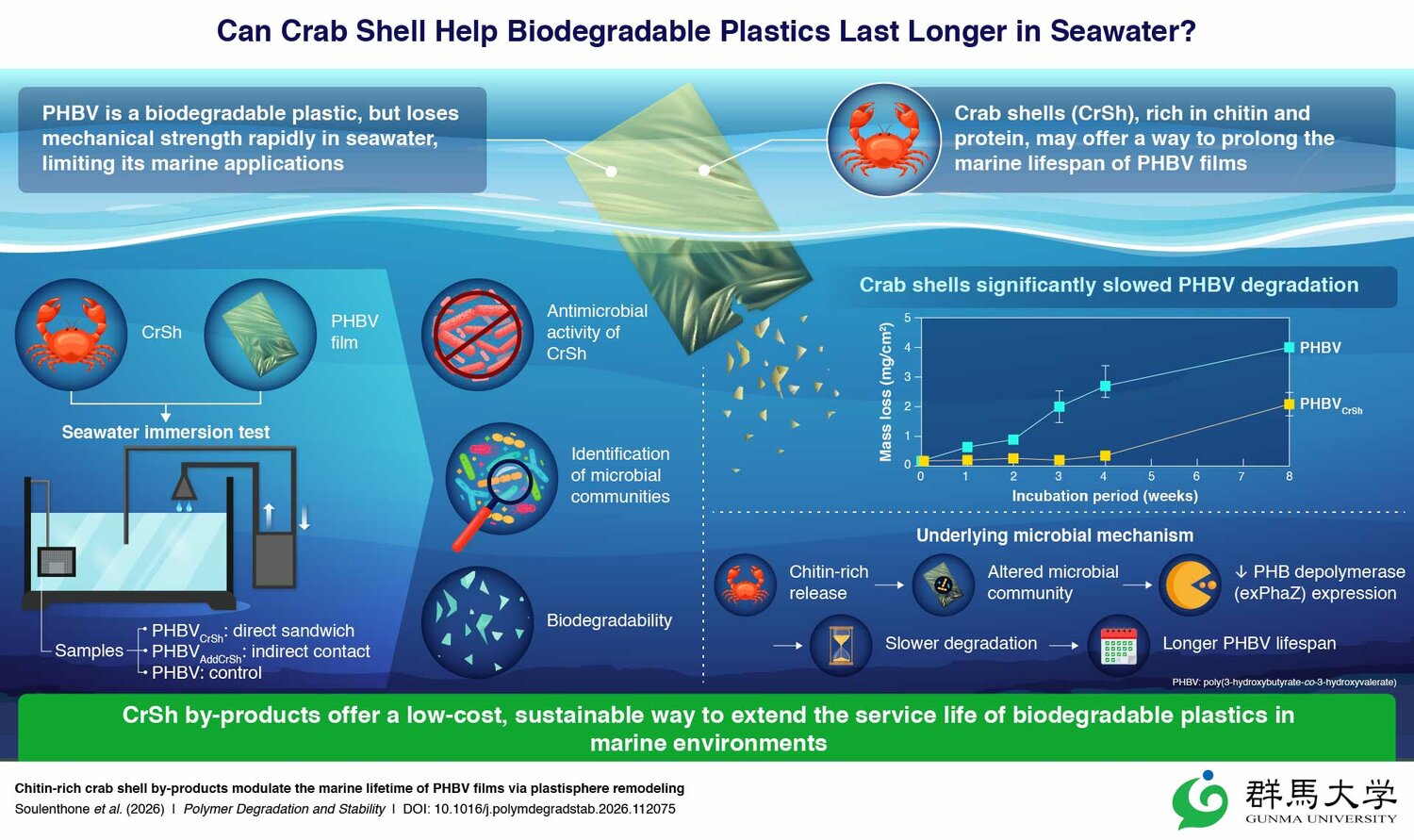
The effect appears to stem from changes in the “plastisphere”—the microbial community that forms on plastic surfaces and drives biodegradation. Instead of acting as a physical barrier, the crab shell material altered which microbes dominated the surface.
Under typical conditions, bacteria such as Oceanospirillum and Bowmanella accelerate PHBV breakdown. When crab shell compounds were introduced, microbial activity shifted toward species like Marinobacter. This shift reduced early enzyme activity linked to polymer degradation, delaying the process.
Chitin, a compound found in crab shells, plays a central role. It acts as an alternative nutrient source, drawing microbial activity away from the plastic. Microorganisms consume the chitin first, effectively postponing the breakdown of the polymer and creating a more controlled degradation timeline.
Beyond performance, the approach has supply chain implications. Crab shells are a common by-product of the seafood industry and are often treated as waste. Repurposing them as functional additives introduces a circular element, linking two industries through reuse.
For manufacturers, the ability to “program” how long a material lasts could expand where biodegradable plastics can be used. Products that previously required conventional plastics due to durability constraints may become viable candidates for bio-based alternatives. The method also avoids more complex chemical modifications, relying instead on naturally available materials.
The research reflects a broader shift in how biodegradable plastics are evaluated. The focus is moving away from how fast materials degrade toward how well their lifespan matches actual use conditions. For marine applications, that balance may ultimately determine whether biodegradable options can scale effectively.


