

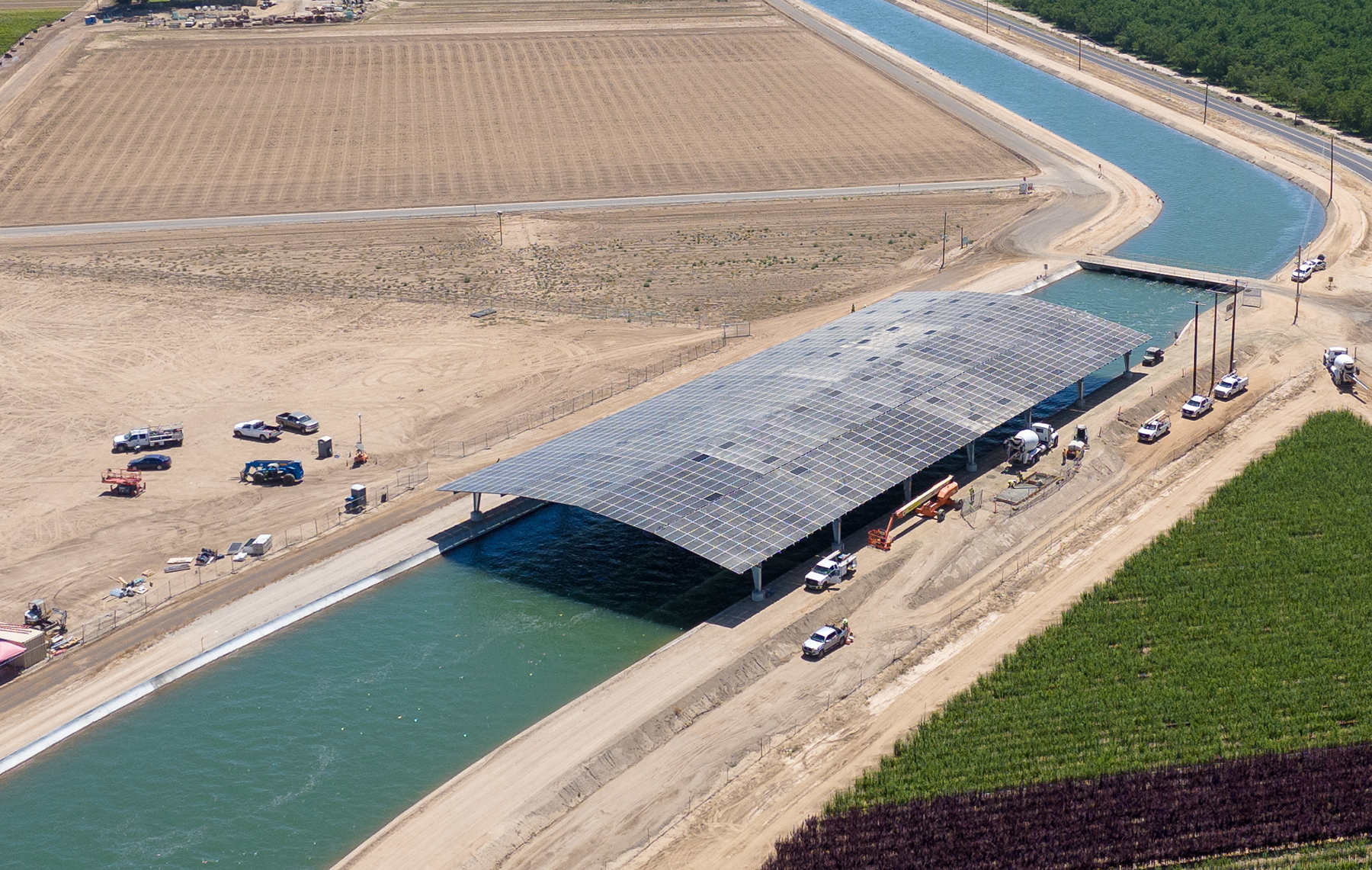
Project Nexus, a partnership between the California Department of Water Resources, the Turlock Irrigation District (TID), solar development firm SolarAquaGrid LLC, and the University of California, Merced, has completed construction of solar panels installed directly over irrigation canals in California's Central Valley. The $20 million project, funded through a state investment approved by Governor Newsom and the Legislature, now enters its active measurement phase.
The concept being tested is straightforward in principle. California operates thousands of miles of open irrigation canals. Water sitting in those canals in a hot, dry climate evaporates continuously before it reaches farms or municipal systems. Solar panels installed over the canals shade the water, slowing evaporation. The panels also generate electricity from the same surface area — without requiring land that would otherwise need to be acquired, permitted, and developed separately.
What Project Nexus Is Measuring and What a Successful Outcome Would Look Like
The pilot is tracking four specific outcomes.
- How much clean electricity the solar installation generates under real operating conditions.
- How much water is conserved by reducing evaporation from covered canal sections compared to uncovered ones.
- Whether shading the canals improves water quality by limiting the algae growth that open water in direct sunlight encourages.
- Whether covering the canals reduces the vegetation growth that currently drives significant maintenance expenditure — the Turlock Irrigation District spends millions annually managing canal vegetation under current conditions.
A UC Merced analysis provided the initial framing for the project, estimating that solar panels over California's open canals could save billions of gallons of water annually if deployed at scale. That figure is a modeling output, not a measured result. Project Nexus is designed to produce the real-world data that would determine whether that estimate holds under actual conditions and what the economics look like at various scales.
Why the Solar Canal Model Is Getting Attention Beyond California
The dual-use infrastructure concept is not new. India has been piloting solar-covered canals since 2012, with a project in Gujarat that generated data on generation yields and evaporation reduction at modest scale. What makes the California pilot significant is its size, the rigor of the measurement framework being applied, and the institutional backing of a state with the regulatory and financial capacity to move from pilot to scaled deployment if results support it.
Water scarcity is not a California-only challenge. Irrigation-dependent agricultural regions across the Southwest, the Mountain West, and internationally face similar tradeoffs between water loss from open canal systems and the cost and land requirements of solar development. If Project Nexus produces evidence that covering canals delivers measurable savings across multiple dimensions simultaneously, the model is replicable. The questions being answered here — actual evaporation reduction rates, generation yield over covered water versus open ground, maintenance cost impact — are the same questions any water authority or agricultural operator would need answered before committing capital to the approach.
Results from the pilot's measurement phase are expected to inform California's 2028 Water Plan. The state has not announced a timeline for when findings will be made public, but the project is now operational and collecting data.


