
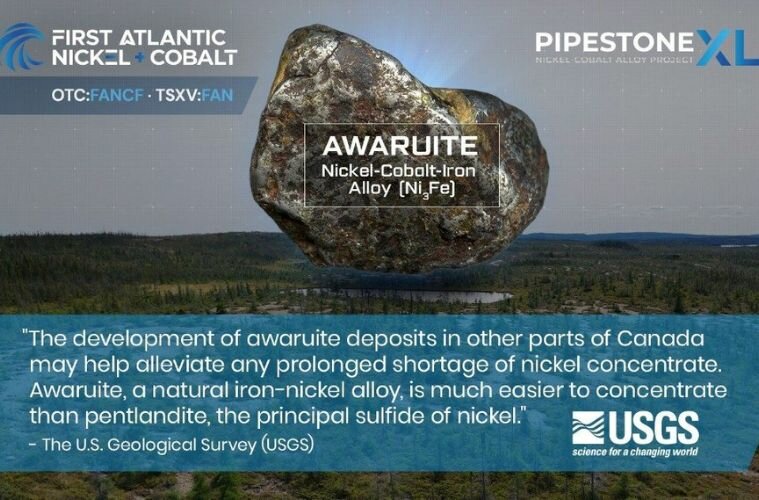
First Atlantic Nickel and Cobalt Corp. received a supplemental exploration permit from the Government of Newfoundland and Labrador this week for its Pipestone XL Nickel-Cobalt Alloy Project. The primary mineral target at Pipestone XL is awaruite (Ni3Fe), a naturally occurring nickel-iron-cobalt alloy whose physical properties allow it to sidestep several of the most expensive and emissions-intensive steps in conventional nickel processing. That distinction matters more now than it did five years ago, as procurement teams building EV, defense, and stainless steel supply chains look for options that reduce overseas midstream exposure.
Why Conventional Nickel Processing Creates North American Supply Chain Vulnerability
The global nickel supply chain runs primarily through Indonesia and the Philippines, where laterite ore deposits dominate production. Processing laterite nickel requires either pyrometallurgical pathways through smelting and roasting, or hydrometallurgical pathways through high-pressure acid leaching (HPAL). Both are energy-intensive and capital-intensive, and both concentrate processing capacity overseas. The U.S. Geological Survey (USGS) added nickel to its critical minerals list in 2022, citing supply concentration and limited domestic processing as primary risk factors. North American manufacturers sourcing nickel for EV battery cathodes, aerospace alloys, defense applications, and stainless steel production currently have few options that keep the full processing chain within the continent.
What Awaruite's Magnetic Properties Change About Processing Economics
Awaruite is a sulfur-free metallic alloy with natural magnetic properties. Those properties allow it to be concentrated through magnetic separation and conventional flotation rather than smelting, roasting, or HPAL. The USGS noted in its 2012 Annual Report on Nickel that awaruite "is much easier to concentrate than pentlandite," the principal sulfide mineral in conventional nickel ore. Skipping HPAL and smelting reduces both the energy intensity and the emissions footprint of producing refined nickel, and eliminates the overseas midstream steps where North American supply chains currently carry the most exposure. First Atlantic is advancing its Alloy Max Zone, a second large-scale awaruite target within the 30-kilometre Pipestone Ophiolite Complex in Newfoundland, alongside its primary drilling program.
IRA Domestic Content Requirements and the Case for North American Nickel Sourcing
The Inflation Reduction Act (IRA) created domestic content thresholds for EV battery critical minerals that increase the commercial value of nickel sourced and processed in North America. Meeting those thresholds requires not just mining domestically but processing domestically, which is precisely where the conventional nickel supply chain falls short. Awaruite's processing pathway can move from concentrate to downstream nickel and cobalt products without the overseas midstream steps that currently disqualify most global nickel from IRA compliance. Pipestone XL remains in the exploration stage, but the combination of processing simplicity, USGS-recognized economics, and a 30-kilometre ophiolite host structure makes it a development procurement and sourcing teams should be tracking.


