
Renewable generation projects have attracted most of Africa's recent clean-energy investment, while the transmission networks and regional interconnections needed to move that electricity have struggled to keep pace. The imbalance is delaying projects, limiting cross-border electricity trade, and complicating the industrial corridors many governments are counting on to attract manufacturing and mining investment.
The African Energy Chamber projects African electricity demand will reach 2,291 terawatt-hours by 2050, more than double estimated 2025 consumption. Separately, AUDA-NEPAD's Continental Power Systems Masterplan estimates that a fully integrated continental power system would require approximately $1.29 trillion in cumulative investment through 2040. A narrower, nearer-term figure has also circulated in African Energy Chamber materials ahead of African Energy Week 2026: roughly $30 billion in additional transmission and grid infrastructure investment to unlock and integrate new generation capacity, a figure describing transmission needs specifically rather than the full continental buildout.
The funding challenge affects the entire energy system, not just transmission. Africa attracts only about 2% of global clean-energy investment despite accounting for roughly one-fifth of the world's population. The International Energy Agency (IEA) found in its 2024 investment analysis that most recent clean-energy investment on the continent has gone to renewable power generation, while average grid line losses of 15% mean inefficient networks and insufficient interconnections are already creating bottlenecks for new renewable projects.
Why Transmission Is Becoming a Binding Constraint
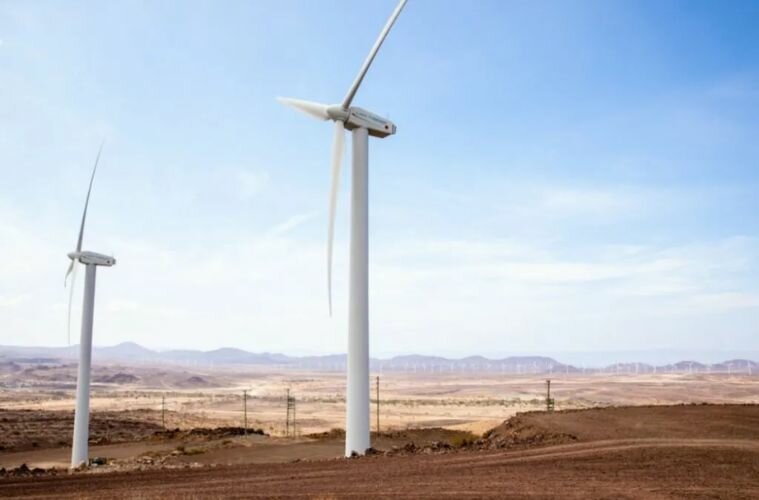
The consequences are visible in completed projects, not just forecasts. Delays finishing the 428-kilometer Loiyangalani-Suswa transmission line left the completed 310-megawatt Lake Turkana Wind Power project, Africa's largest wind installation, unable to deliver its full output to Kenya's grid for an extended period. The case demonstrated that financing generation does not guarantee the electricity can reach customers when the associated network infrastructure follows a different development schedule. Across the broader Middle East and North Africa region, electricity consumption is expected to rise roughly 50% by 2035, according to the IEA, driven principally by cooling, desalination, population growth, and rising incomes, adding further pressure to grids not designed for that scale of demand. Generation investment continues across renewables, gas-to-power, and hybrid systems. Without corresponding transmission and interconnection spending, however, new capacity risks being delayed, curtailed, or underutilized because the grid cannot reliably deliver its output.
Regional Power Pools Are the Response, With Mixed Progress
The response taking shape is regional interconnection rather than country-by-country fixes. Following a successful region-wide synchronization test in November 2025, the West Africa Power Pool targeted permanent synchronization of its participating grids by the end of June 2026, a milestone the African Finance Corporation has described as critical to unlocking large-scale hydropower potential and industrial demand across the region. That target date has now passed, and whether the region has actually completed permanent synchronization should be confirmed before treating it as accomplished.
Work is separately advancing to connect the Eastern African Power Pool more fully with Tanzania and, ultimately, the Southern African Power Pool, though no firm, authoritative date for full synchronization between the two pools has been confirmed. The Ethiopia-Kenya interconnector, part of a broader planned electricity highway extending toward Tanzania and the Southern African Power Pool, can already transfer up to 2,000 megawatts and has been in commercial operation since late 2022, offering one working example of what cross-border trading at scale can look like once the connecting infrastructure is actually built.
Bankable Structures Remain a Central Constraint
Infrastructure alone will not solve the underlying investment problem. Investors frequently identify weak utility balance sheets, currency exposure, inconsistent tariff frameworks, political risk, and a shortage of well-prepared projects as major barriers to transmission finance in Africa, alongside the more commonly cited absence of standardized offtake structures and creditworthy counterparties. There is investor interest in African transmission, but that does not mean available capital is unconstrained.
Kenya advanced a $311 million transmission public-private partnership with Africa50 and Power Grid Corporation of India in late 2025, which Africa50's chief executive described as an Africa-first Independent Power Transmission model that could be replicated elsewhere on the continent.
The World Bank is separately providing $12 million in technical assistance to the Southern African Power Pool and regional institutions to expand electricity trading, strengthen market rules, and prepare future investments. Scaling private transmission finance beyond these early cases will depend on replicating it in markets with strong independent power producer track records, particularly in East and Southeastern Africa, rather than assuming the model transfers automatically everywhere.
What This Means for Companies Evaluating African Investment
For manufacturers, miners, and industrial investors evaluating African markets, the transmission gap changes how due diligence should work. Industrial corridors like Lobito and Simandou are valid examples of mineral and logistics corridors with major energy requirements, though they are not interchangeable: Lobito is supported by governments and development institutions as an infrastructure and critical-minerals corridor, while Simandou is primarily a mine, rail, and port development, and neither should be treated automatically as a proven model of transmission-led industrial development without project-specific verification. The proposed Liberty Corridor in Liberia and Guinea, put forward by Ivanhoe Atlantic, remains an earlier-stage example worth the same scrutiny. Countries elsewhere have already learned that grid readiness functions as a timeline variable in corporate planning, not just a cost input, and the same discipline applies to evaluating African industrial corridors specifically.
South Africa's own reforms, including private transmission investment and electricity trading changes alongside continued grid congestion, offer a reasonable regional case study, though any claim about what has and hasn't worked there needs grounding in specific reforms and outcomes rather than general impression. Aging, centralized transmission networks have already shown how quickly an uncritical dependence on them can turn into an operational liability elsewhere in the world. Companies that confirm transmission commitments directly, rather than relying on generation announcements or regional trading-bloc targets, will have a clearer picture of which African industrial corridors are actually financeable on the timeline they need. Treating infrastructure availability as a given, rather than something to check firsthand, is a habit that has cost other companies planning around grid constraints elsewhere.


