
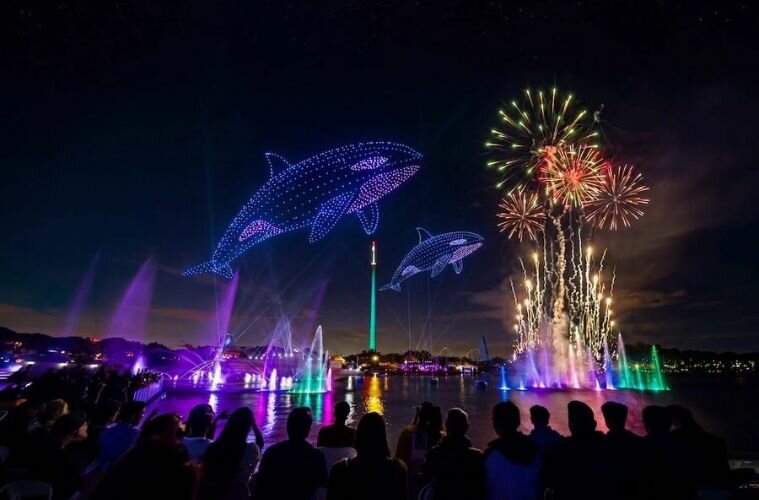
The environmental impacts of fireworks are well established. What has changed over the past year is the precision of the science. New research is identifying the specific metals released into the air, renewed federal attention is focusing on perchlorate contamination in drinking water, and communities are increasingly weighing whether traditional fireworks still align with their environmental and public health goals.
A 2025 study published in Atmosphere found that Independence Day fireworks in Southern California produced some of the highest airborne concentrations of fireworks-related metals reported in the scientific literature, particularly barium, copper, and strontium, with particulate matter (PM) levels exceeding 500 micrograms per cubic meter during peak periods.
Cal State Fullerton Study Finds Record Metal Concentrations From July 4 Fireworks
The California State University, Fullerton research measured barium, chromium, copper, lead, and strontium in airborne particles collected near the campus over two Independence Day holidays, 2020 and 2021. Chemistry professor Daniel Curtis, who led the study, has said preliminary data from more recent years shows metal concentrations climbing even higher than those readings. Graduate researchers are now analyzing particle samples collected in 2024 and 2025 to determine whether that trend is continuing.
The findings matter for facilities and environmental health and safety (EHS) teams that monitor air quality near event venues. Fine particulate matter reaches deep into the lungs and bloodstream, and the metal-specific data turns a general air-quality concern into something closer to a measurable exposure profile.
EPA Proposes a Perchlorate Rule After Shelving Its Own Fireworks Study
The water side of the story moved just as fast, in the opposite direction. The U.S. Environmental Protection Agency (EPA) proposed a national drinking water standard for perchlorate on January 6, 2026, setting a health-based goal of 20 parts per billion after a federal court ordered the agency to act. Perchlorate is an oxidizer widely used in fireworks propellants and explosive compositions, and the U.S. Geological Survey has documented it in the large majority of surface water samples collected nationally.
According to comments submitted by the Natural Resources Defense Council (NRDC) in March 2026, the EPA had halted a study examining fireworks-related perchlorate contamination after preliminary monitoring had begun. NRDC argued the study should have been completed before the agency finalized its rulemaking. Public comments on the EPA's proposed rule closed March 9, 2026, and the agency is legally required to finalize a standard by May 2027.
Cities Are Split on Fireworks Alternatives for July 4, 2026
Two neighboring Orange County cities illustrate how unresolved this question still is. Laguna Beach tried a drone show in 2024, returned to fireworks in 2025, and is using fireworks again this year, while neighboring Laguna Niguel is staging its own drone display a few miles away. In Colorado, Douglas County commissioners were still weighing whether to revive a canceled Highlands Ranch fireworks show this week despite drought conditions, after the county's wildfire safety board chair argued publicly for a permanent shift to drones.
No single technology is emerging as the clear winner. Drone shows avoid combustion byproducts and the wildfire ignition risk fire marshals increasingly cite when denying permits, but manufacturing the batteries and electronics carries its own footprint, one that depends on show size, equipment lifespan, and how far crews travel to operate it. For sustainability and EHS teams advising on event planning, neither option is free of tradeoffs, and the research base for comparing them is only now catching up to the decisions communities are already making.


